01Origin
Where does Mazatapec come from? The name and the origin claim
Claimed origin, checked against the record
Updated
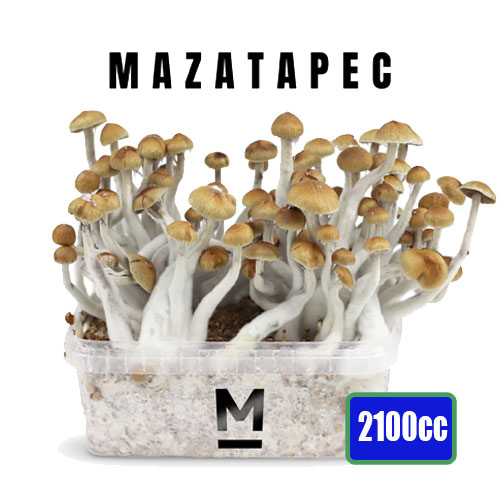
Mazatapec is sold as a Psilocybe cubensis culture from the Mazatec region of northern Oaxaca, Mexico. Dutch-Smart's XXL kit page puts it this way: Mazatapec is "named after the Mazatec region in Mexico where the strain originates" (Mazatapec XXL). That claim is plausible, because cubensis grows in Oaxaca. It cannot be traced to a documented collection: no publication, herbarium record or culture collection that we could find names a collector, a place or a year.
What the name says
The name joins two things. "Mazatec" is the name of the Indigenous people of the Sierra Mazateca in Oaxaca and neighbouring parts of Puebla and Veracruz. The ending "-tepec" is a common Nahuatl place-name element meaning hill: the town of Mazatepec in Morelos takes its name from the Nahuatl words for deer and hill (Wikipedia, Mazatepec).
We could not find a town or village spelled Mazatapec in Oaxaca. That does not prove the story wrong. Names in the growing hobby are often shortened, misspelled or invented, and the spelling on spore and kit labels varies. It does mean the name alone is no evidence of a precise place of collection.
Does cubensis grow there at all?
Yes. In a 2008 overview, the Mexican mycologist Gastón Guzmán divided Mexico's hallucinogenic species into three ecological groups (Guzmán, 2008):
- species of tropical lowland forest;
- the dung species of pastures, P. cubensis and P. subcubensis;
- the large group of the subtropical cloud forest zone between 1,000 and 1,600 metres, where P. cubensis turns up in meadows next to P. mexicana.
In the same paper Guzmán lists P. cubensis among the species used in Oaxaca, together with P. caerulescens, P. mexicana and P. zapotecorum. A cubensis culture taken from a pasture in or near the Mazatec region is therefore entirely possible.
The short history behind the name
The Mazatec region became known abroad in the 1950s, after outsiders took part in night-time mushroom ceremonies in Huautla de Jiménez and wrote about them. Guzmán notes that the ceremonies there used several species, and that recreational visitors and tourism changed them in the decades that followed. The cultivar name borrows the reputation of that history. It says nothing about which mushroom, from which ceremony or pasture, ended up in a spore syringe.
What the genetic data show
Two genetic studies help, within limits.
In 2021 a team led by Kevin McKernan sequenced the genomes of 81 Psilocybe samples, including spore samples sold as Mazatapec, and deposited the data in public databases (McKernan et al., 2021). Mazatapec had complete coverage of the genes that produce psilocybin. That confirms it is an ordinary psilocybin-producing cubensis. It does not show where the culture first came from.
In 2023 a study compared 86 genomes of commercial cubensis cultivars with 38 wild isolates from Australia (McTaggart et al., 2023). The cultivars had very little genetic diversity, carried signs of self-fertilisation and clonal propagation, and most traced back to related populations. Put simply: a cultivar name such as Mazatapec usually marks a line within one closely related family, not an independent wild population.
A 2025 review of cubensis strains adds that strain descriptions are "predominantly sourced from non-academic, community-based reports" (Kurzbaum et al., 2025). It mentions Mazatapec by name, as a strain connected to the spiritual traditions of the Mazatec region, and gives no collection details.
Other Oaxacan names on the market
Mazatapec is one of several cultivars named after places in Oaxaca. DoubleBlind magazine traced the Huautla cultivar to spores that began circulating online in the late 1990s, reportedly collected in pastures near Huautla de Jiménez; the exact collection date is unknown (DoubleBlind, 2024). For Mazatapec we found no comparable account.
How to read the label
| Statement | Status |
|---|---|
| Mazatapec is Psilocybe cubensis | documented by genome sequencing (2021) |
| It produces psilocybin | documented: complete psilocybin gene cluster |
| Cubensis grows and is used in Oaxaca | documented by Guzmán (2008) |
| It was collected in the Mazatec region | claimed by shops, no record found |
| Collector, place and year | unknown |
| A calm, introspective character | shop description, see strength |
For buying, the origin story makes no practical difference: what you get is a cubensis kit, and the kit guide compares the three formats. For the law, the name makes no difference either; the law page explains why.